
Horizontal Directional Drilling (HDD)
Precision Trenchless Pipeline Installation
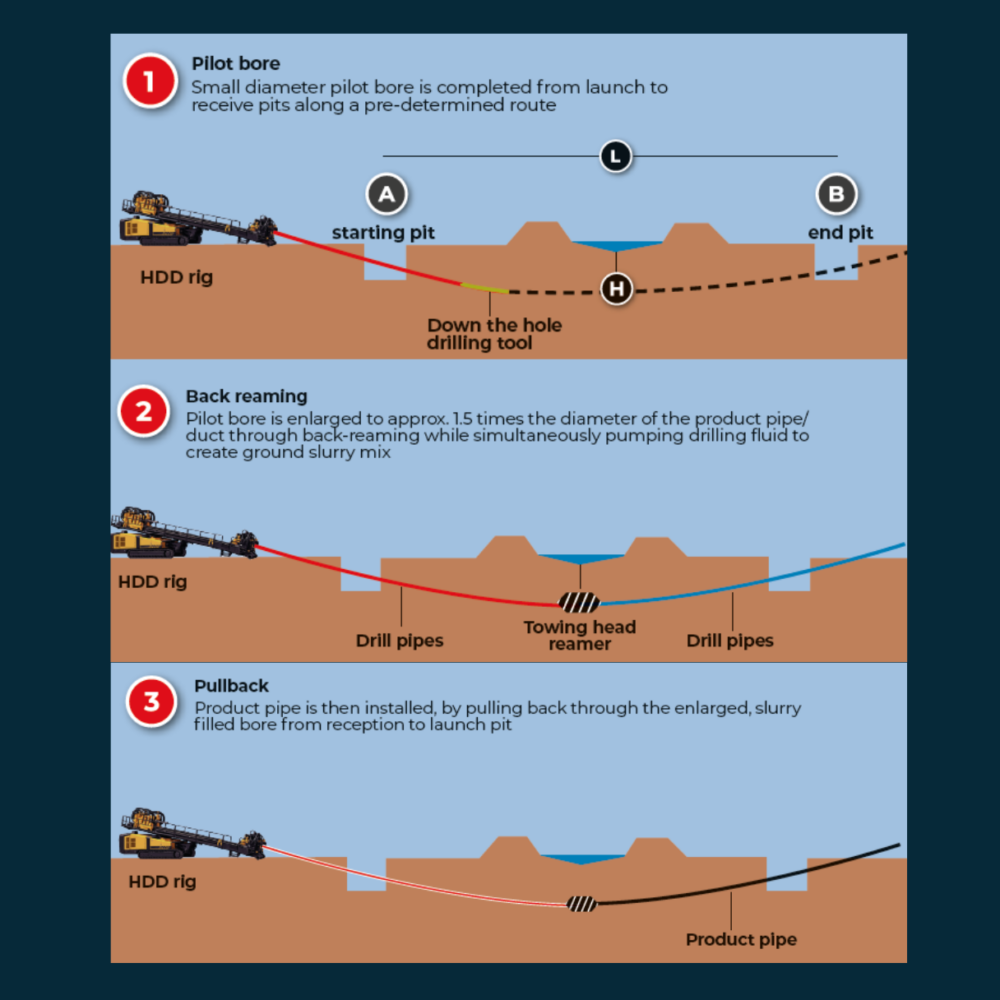
Stage One: Pilot bore
The process begins with a pilot bore, where a steerable drill head creates the planned route between the entry and exit points. Engineers continuously monitor alignment and depth, while drilling fluid is used to cool and lubricate equipment, stabilise the bore and remove spoil. Once approved, the pilot bore is prepared for enlargement and pipe installation.
Stage Two: Hole Enlargement
The pilot bore is progressively enlarged using specialised reamers to create the required diameter for the pipeline or duct. Multiple passes may be completed to suit ground conditions and maintain bore stability, ensuring sufficient clearance for the final installation.
Stage Three: Product Pipe Installation
Once the bore has been enlarged to the required diameter, the product pipe is attached to the drill string and carefully pulled through the bore. Throughout installation, pullback forces and alignment are closely monitored to ensure the pipe is installed safely, accurately and in line with the design requirements.
Product Pipe Installation & Quality Assurance
Once the bore has been enlarged to the required diameter, the product pipe is attached to the drill string and carefully pulled into position. Throughout installation, pullback forces, alignment and bore conditions are continuously monitored to ensure the pipeline is installed safely, accurately and in accordance with the design requirements. Following installation, the asset is inspected and tested to confirm compliance with project specifications. This may include pressure testing and disinfection for water mains, integrity testing for coated steel pipelines, and alignment verification where tight tolerances are required for gravity sewers.
Successful HDD delivery relies on maintaining control throughout every stage of the process. From confirming the accuracy of the pilot bore and managing bore stability during enlargement, to monitoring loads and installation parameters during pullback, each phase plays a critical role in achieving a safe and successful outcome.
This disciplined approach enables HDD to be used across a wide range of infrastructure projects, including water and wastewater networks, utility installations, cable corridors, cross-country pipelines, sea outfalls and other complex crossings. By reducing surface disruption and minimising environmental impact, HDD provides a reliable and efficient solution for challenging underground installations.
Horizontal Directional Drilling (HDD)
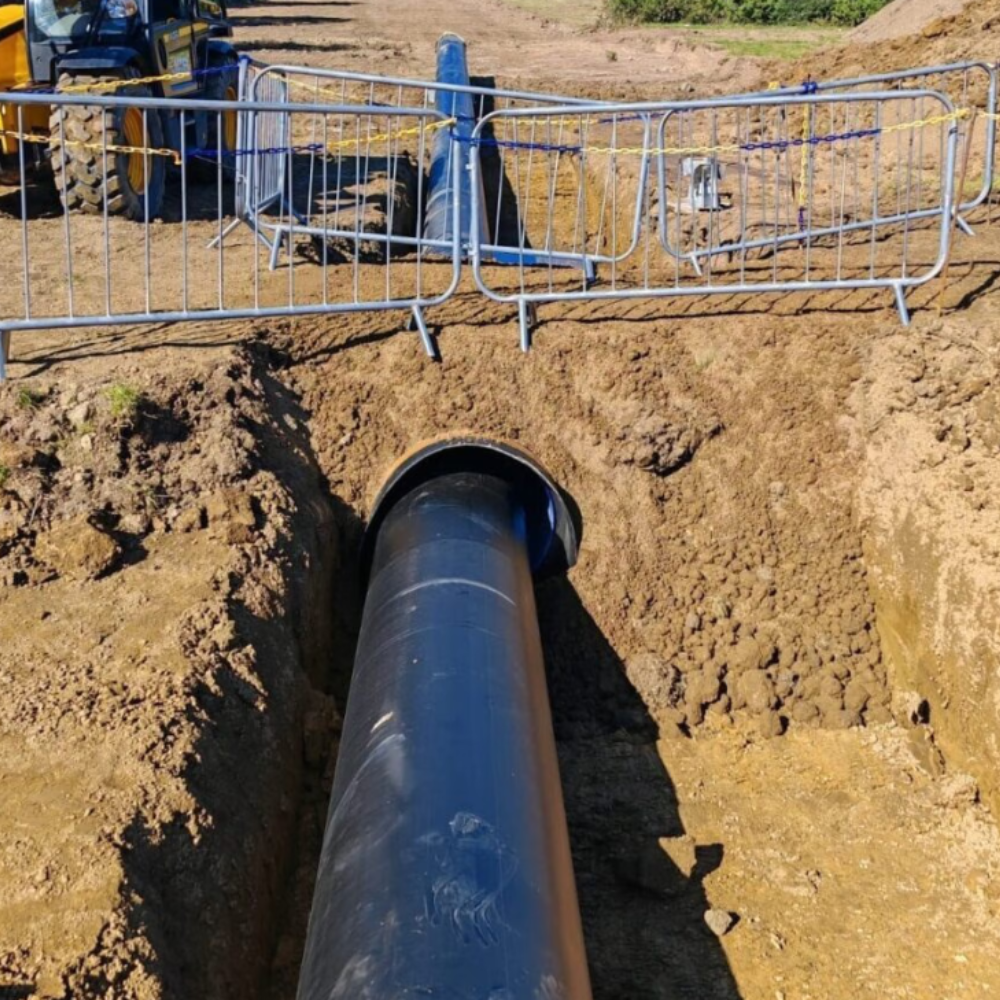
We provide steerable, trenchless HDD solutions for the installation of underground pipes, ducts and cables, offering a cost-effective and low-impact alternative to traditional open-cut construction.
Supported by specialist plant and experienced teams, we undertake crossings beneath roads, railways, rivers, runways and coastal environments. Our expertise enables the safe and efficient completion of complex underground works across a wide range of ground conditions while minimising disruption to surrounding communities and the environment.