Sector:
Environmental and Renewables
Client:
Transport Scotland
Main Contractor:
QTS
Location:
Tay Crossing to Ballinluig

Contact usTo hear about our experiences and how we can help you.

Project Overview
As part of Transport Scotland’s A9 Dualling Programme, the section of the A9 trunk road between Tay Crossing and Ballinluig is being upgraded from a single carriageway to a dual carriageway. The scheme forms part of a wider strategic infrastructure improvement aimed at increasing road capacity, improving safety, and enhancing journey reliability between Perth and Inverness. A key element of the project involves the design and construction of surface water drainage infrastructure to collect, treat, and safely discharge runoff from the proposed dual carriageway.

 The drainage strategy includes the provision of a Sustainable Drainage System (SuDS) basin, located to the west of the A9, to treat and attenuate surface water runoff prior to discharge. Surface water from the carriageway is conveyed via a series of drainage pipes from the SuDS basin towards the River Tay, which serves as the final outfall. However, the presence of the Highland Main Line railway (Perth–Inverness) presents a significant constraint, requiring the drainage to cross beneath the live railway corridor. To overcome this constraint, the design incorporates two undertrack crossings (UTXs) constructed using microtunnelling pipe-jacking techniques. Each UTX consists of a 900 mm internal diameter sleeve pipe, installed between a launch shaft and a reception shaft positioned to the west and east of the railway and road corridor respectively. This method was selected to minimise disruption to railway operations and ensure ground stability during construction.

  • UTX-1 has a drive length of 27.45m
  • UTX-2 has a drive length of 51.02m

Following completion of the microtunnelling works, a 375mm internal diameter (426mm external diameter) Aqua 16 TDK carrier pipe is installed at the crown of the sleeve pipe using adjustable brackets. Once the pipe is set to the correct grade, block walls are constructed at both ends of the tunnel. The annular void between the sleeve pipe and the carrier pipe is then filled with foam concrete supplied by Breedon Concrete, providing structural support and long-term durability.

Technical Details

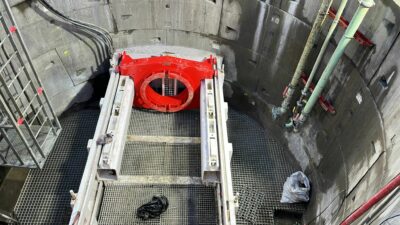
The works comprise a total of four shafts. The shaft construction includes a 5.5m internal diameter, 5m deep drive shaft and a 3.66 m internal diameter, 5m deep reception shaft, all shafts constructed using segmental construction. The tunnel size consists of a 900 mm internal diameter undertrack crossing, with UTX-1 measuring 27.45m in length and UTX- 2 measuring 51.02m in length.

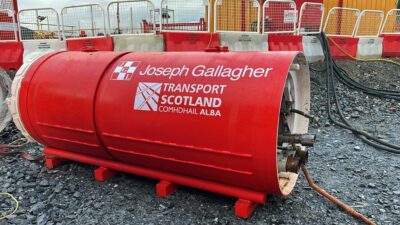
The tunnel lining comprises concrete with an Aqua pipe installed internally. Microtunnelling was carried out using a Herrenknecht AVN 800 TBM with rear canister. The completed drive length for the recorded crossing was 27.45 m, with a tunnel/pipe diameter of 900 mm. A total of two crossings were constructed. The ground conditions encountered consisted of cobbles, silt, and sand with a high water table.

The works were carried out using trenchless methods, with open-cut excavation not applicable. A total of 346 m³ of concrete was poured during the works, with no muck-away recorded.

Our Approach

We were governed by the site situation on arrival. The client (QTS) had completed the compound for UTX-1 and had yet to commence UTX-2. Construction of the UTX-1 drive shaft collar took place on 27 October 2025. During shaft excavation, a high quantity of boulders was encountered, some of which were quartz, an extremely hard material with strengths of up to 320 MPa. This proved to be the deciding factor in changing the microtunnelling machine from an Iseki to a Herrenknecht machine. The development of the mud plan also had to be revised to accommodate the changed ground conditions and the new machine. At this stage, the change from a 1,200 mm pipe to a 900 mm pipe required a return to redesign, and further approvals were required from QTS and Network Rail.

Once AFC approval was received, tunnelling commenced. During the tunnelling works, issues were encountered with the electrical system and the hydraulic power pack; these were resolved through the provision of a standalone power pack. These delays extended the works up to the Christmas break. Following the Christmas break, installation of the Aqua pipe commenced. This proved to be particularly challenging, as the pipe had originally been designed to be installed within a 1,200 mm sleeve, but was now being installed within a 900 mm pipe, leaving 300 mm less working space, which resulted in very tight installation conditions.

Challenges

Weather
We experienced several very cold days during January, with temperatures ranging from –8°C to 0°C. This caused significant issues getting equipment to site and carrying out works, with materials and equipment freezing. These issues were overcome by clearing access roads, ensuring all personnel were kept warm while working, and implementing regular breaks to maintain safe working conditions.


Remoteness of the Project
The remote location of the project also presented challenges. Communication with suppliers was required to direct them to site, with language barriers occasionally causing difficulties. In some cases, it was easier to track suppliers’ locations and go out to meet them directly.


Groundwater
Groundwater presented a significant issue, particularly at the UTX-2 drive shaft, where water ingress was encountered following base construction, leaving the shaft underwater. The shaft was pumped out and found to be leaking. It was decided to install a steel plate fixed to the base, followed by grouting to seal the leakage.


The grouting works were carried out underwater with a positive head to prevent grout entering the shaft and to force it into the surrounding ground. Upon pumping the shaft down again, water ingress was still observed from the base. As a result, the decision was made to break out the base and re-pour. As of the current date, the shaft is still leaking, although at a significantly reduced rate. Assistance from Tempo is now being sought to provide a permanent seal.

Community Involvement

All works were closely coordinated with the QTS Construction Manager, as the tunnels were crossing the A9, which is a busy main route to the north, included two crossings beneath the Highland Main Line (Perth–Inverness). Monitoring points were installed to check ground movement as the works passed beneath these assets. As of today, the rail crossings have been completed with no disturbance reported.

Environment and Sustainability
Considerations

With the project being located within a farmers` field and in close proximity to the River Tay, all necessary precautions were implemented to eliminate the risk of spillages or contamination. Environmental controls were put in place to protect surrounding land and watercourses throughout the duration of the works.

Added Value

The project delivered strong added value through its adaptive approach to challenging conditions. Encountering extremely hard quartz boulders prompted a switch to a Herrenknecht AVN 800 TBM, ensuring tunnelling could continue safely and effectively. The team further refined the mud plan to suit the revised methodology and ground conditions, improving reliability and reducing delays.

Value was also added through a flexible redesign and coordination when the carrier pipe needed to be installed within a smaller 900 mm sleeve, requiring careful approvals and precise installation in very restricted spaces. Groundwater challenges at UTX‑2 were mitigated through underwater grouting, steel plate installation, and eventually a full base re‑pour, improving long‑term performance.

Operational resilience - including managing remote site logistics and severe winter weather - helped maintain progress while ensuring safety.

Awards

We worked closely with the QTS staff on site, and they were awarded the JGL Best Practice Award on approximately four occasions during the project, demonstrating the close working relationship maintained onsite throughout the works.

To hear about our experiences and how we can help you.

Explore related content

Shaft Sinking

Services

Experts in shaft sinking, delivering safe, precise vertical excavation, ground support, lining installation, and deep access infrastructure solutions.

Civil and Structural Works

250620 JGL Finham 604

Services

Specialists in civil and structural works, delivering safe, precise construction, reinforced concrete, steel structures, and infrastructure solutions.

Environmental and Sustainability Services

Services

Delivering low impact, eco-conscious solutions that protect the environment in infrastructure, enhancing sustainability and regulatory compliance.

Ground Improvement and Enabling Works

Services

Specialists in ground improvement and enabling works, delivering safe site preparation, remediation, utilities, drainage and construction readiness.