- Sector:
- Utilities
- Client:
- Severn Trent
- Location:
- Finham, Coventry
Contact usTo hear about our experiences and how we can help you.
Project Overview
Finham Sewage Treatment Works (STW) serves a population equivalent of approximately 560,000 in Coventry, treating around 115ML of wastewater daily. As part of the UK Government’s 2022 Green Recovery programme, Severn Trent committed to major investment in water quality, sustainable growth and nature‑based solutions.
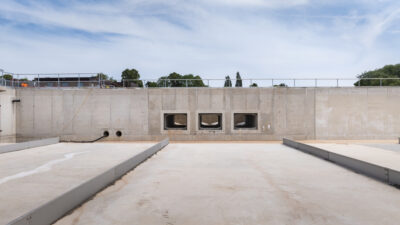
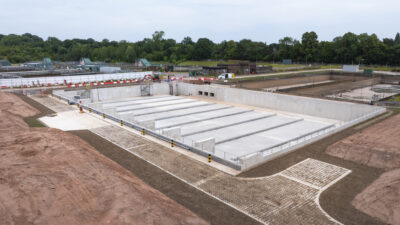
The Finham Storm Tank Project formed a key component of the Bathers River Challenge, delivering a new 4,800m³ stormwater tank to significantly reduce storm overflow spills into the River Avon and improve river water quality.
Alongside the main STW works, additional construction included a 5,960m³ reinforced‑concrete stormwater holding tank, extensive piling, concrete works and the installation of new pipework and access infrastructure.
Project Background
The scheme was designed to work in combination with the storm tank at Unicorn Lane CSO, providing increased stormwater storage capacity across the catchment.
These assets ensure that storm flows can be held temporarily and returned for treatment once conditions stabilise, reducing discharges and improving environmental compliance.
Early phases advanced smoothly through strong collaboration between design, delivery, and operational teams. However, ground conditions identified during excavation required a redesign of the original tank concept. An Integrated Project Team (IPT) model enabled rapid decision‑making, ensuring progress continued and the project achieved operational readiness before the regulatory deadline of 31 March 2025.
Challenges
The original design proposed a 15-20m deep circular shaft supported by diaphragm walls. During initial excavation, the team uncovered previously unknown sub‑artesian groundwater pressures, creating a risk of water ingress and soil instability. This discovery required an immediate halt to work and a fundamental redesign of the storm tank solution.
Key challenges included:
- Managing groundwater inflow and subsurface instability.
- Reducing excavation depth to avoid triggering further groundwater movement.
- Re‑engineering piling, reinforcement, and slab design.
- Maintaining programme deadlines despite major technical changes.
- Ensuring safety control and coordinated working across multiple contractors and workstreams.
Through collaborative design sprints, the team adopted a shallower rectangular tank supported by rotary bored piles (650–750mm diameter, up to 1000kN tension resistance). This mitigated groundwater risks while maintaining structural performance. A reinforcement optimisation exercise further reduced steel quantities, lowering both carbon and costs.

Services Provided
Major construction and engineering works included:
- Installation of 77 rotary bored piles with casing and subsequent pile cropping.
- Construction of a 1,800m² reinforced‑concrete slab (400mm thick) with power‑float finish.
- Casting 4-metre‑high tapered reinforced‑concrete walls with Sika Supercast movement joints.
- Installation of three new culvert runs.
- Cutting and removal of existing reinforced‑concrete wall sections.
- Installation of 400mm ductile iron pipework and 160mm OD SDR17 PE pipework (140m open‑cut).
- Trench boxes, trench sheets, and protective measures around existing service crossings.
- Backfilling and compaction around the tank structure.
- Construction of new footpaths, kerbing, bollards, grasscrete, areas and tarmac access road.
- Installation of hot‑dip-galvanised handrailing around the tank perimeter.
Temporary and permanent works design services included:
- Temporary formwork for tapered reinforced-concrete (RC) walls (DOKA
- Internal JGL temporary-works design for crane platforms and concrete cutting assessments.
- Ground Force trench support for rising main installation
- Permanent piling design and structural detailing.
- Provision of crawler cranes, telescopic boom cranes, access equipment, ventilation, storage and lifting gear.
Environmental and Community Impact
The storm tank significantly reduces storm overflow discharges into the River Avon, enhancing water quality and supporting compliance with the Water Framework Directive. Environmental improvement measures include Biodiversity Net Gain assessments, bird‑box installation, and a tree‑replanting programme to restore habitats affected by construction.
Community engagement was supported with newsletters, construction updates, video content and a dedicated Bathing Rivers virtual room, improving public awareness of river quality improvements.
Legacy
Despite substantial technical challenges and a major mid‑project redesign, the 4,800m³ storm tank was delivered on time, to a high standard, and within regulatory deadlines. The combined works at Finham demonstrate how flexible engineering, proactive problem‑solving, and collaborative delivery can achieve resilient wastewater infrastructure that strengthens environmental outcomes and community value.
The project leaves a lasting legacy of improved river water quality, enhanced ecological conditions, and a model of integrated working that can be replicated across future UK water infrastructure schemes.
To hear about our experiences and how we can help you.
Explore related content
Civil and Structural Works
Specialists in civil and structural works, delivering safe, precise construction, reinforced concrete, steel structures, and infrastructure solutions.
Environmental and Sustainability Services
Delivering low impact, eco-conscious solutions that protect the environment in infrastructure, enhancing sustainability and regulatory compliance.
Asset Inspection and Rehabilitation
Delivering safe, precise assessment, inspection, repair and renewal of infrastructure assets to extend service life and ensure long-term performance.
Ground Improvement and Enabling Works
Specialists in ground improvement and enabling works, delivering safe site preparation, remediation, utilities, drainage and construction readiness.